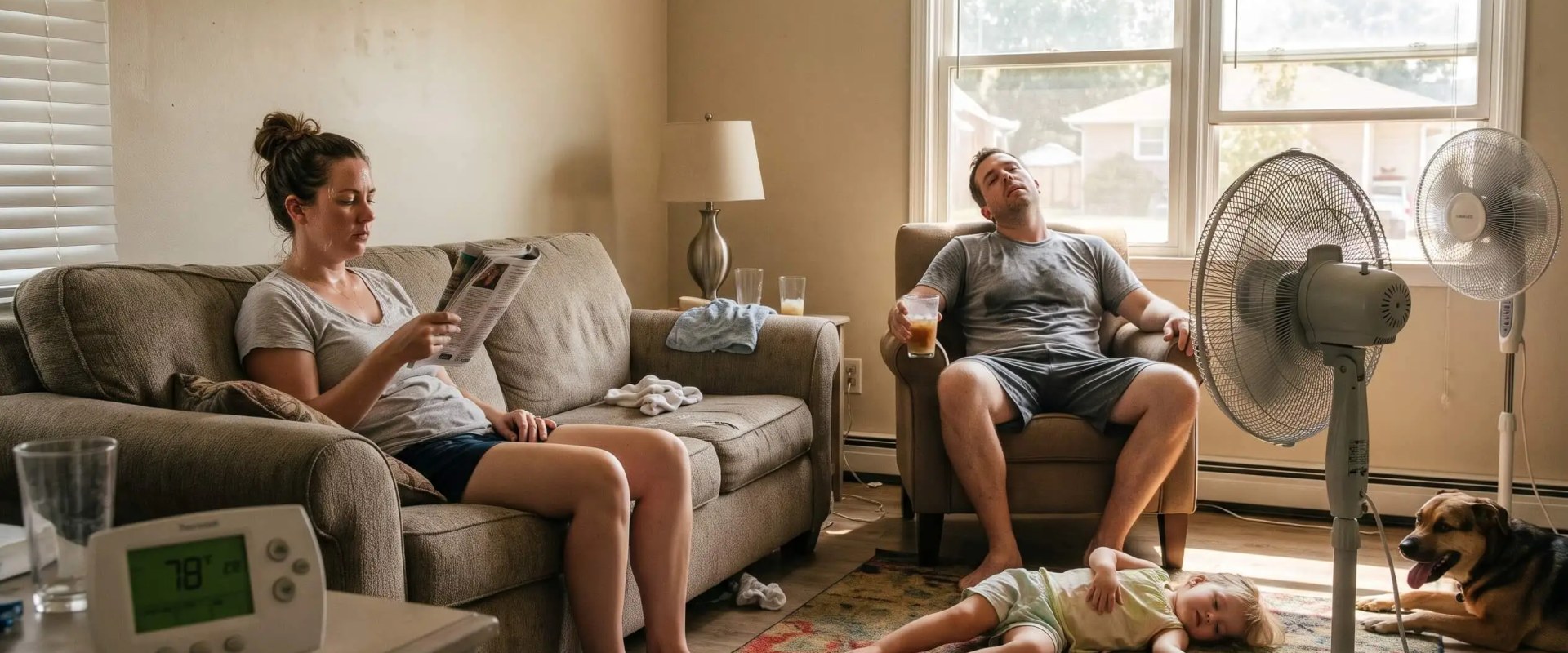
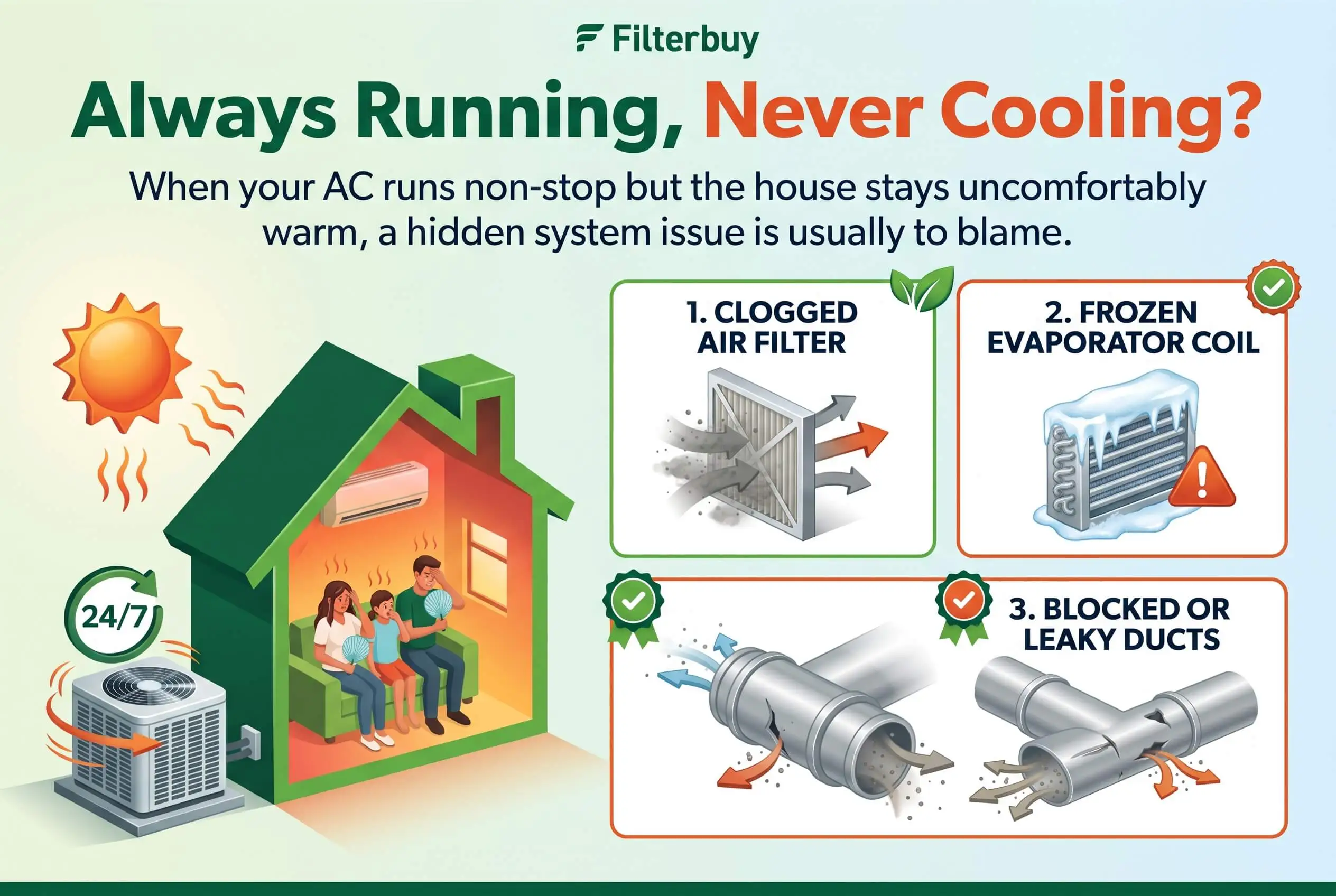
Your air conditioner has been running since noon. The thermostat still reads 78, and the air feels thick enough to wear. When an air conditioner is not blowing cold air but running anyway, the cause usually comes down to four suspects: restricted airflow, a refrigerant leak, ducts leaking cooled air before it reaches your rooms, or a system sized wrong for the house.
The good news is that you can narrow that list yourself, and the most telling check needs only a kitchen thermometer.
TL;DR Quick Answers
air conditioner not blowing cold air but running
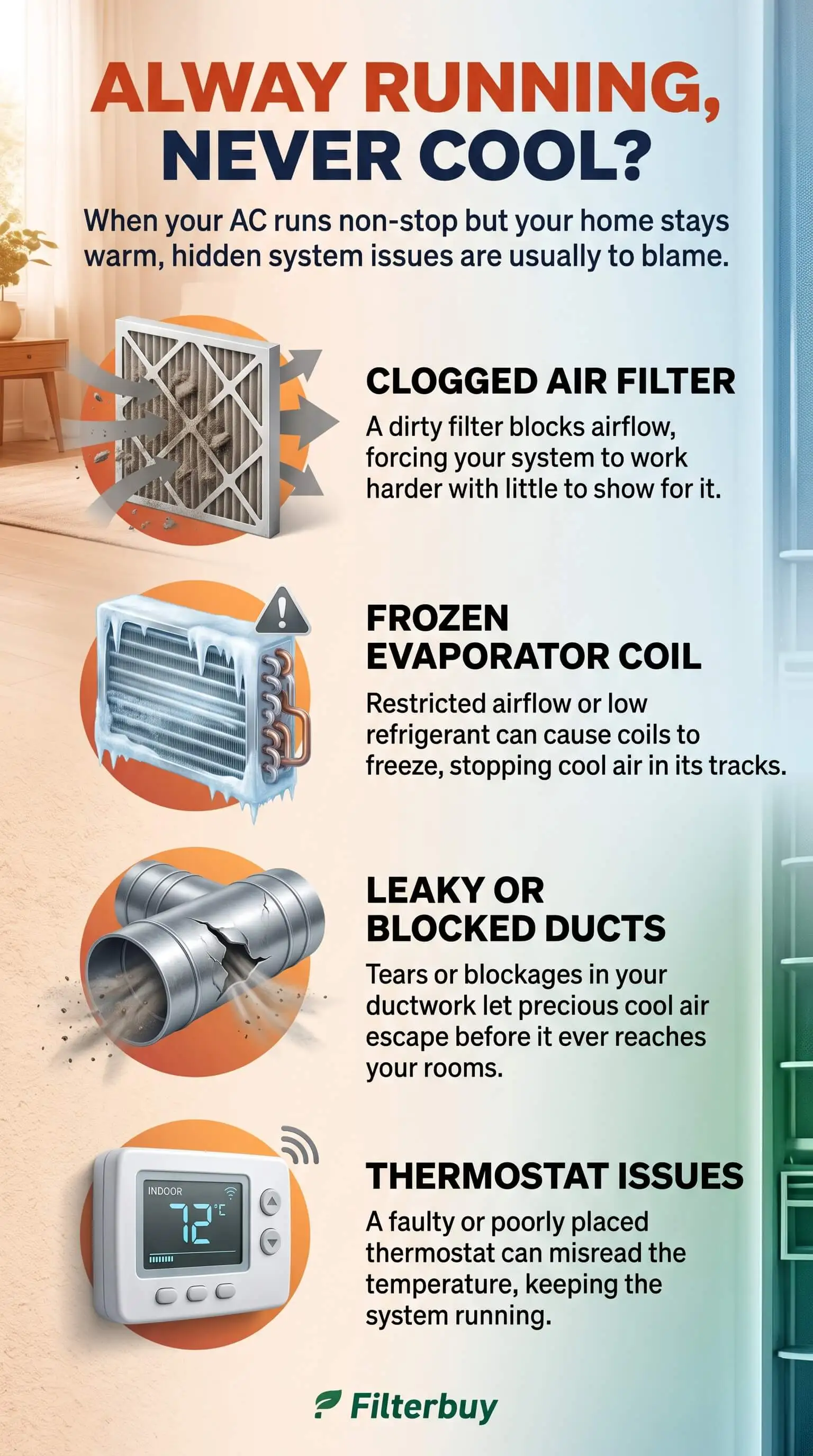
When an air conditioner runs but doesn’t blow cold air, the cause is usually restricted airflow from a clogged filter or dirty coil, low refrigerant from a leak, leaky ducts, or a system sized wrong for the home. Check the filter first, then compare the air temperature at a return grille and a supply vent.
Lukewarm air at the vents: Look at the filter, the indoor coil, or the refrigerant charge.
Ice on the copper lines: Switch the thermostat to Fan Only until it thaws, then replace the filter. Ice that comes back points to a leak.
Cool air but humid rooms: Suspect short cycling or airflow set too high for your climate.
Cool near the unit, warm in far rooms: Inspect the ductwork for leaks or crushed runs.
Frost, hissing, or a breaker that keeps tripping: Turn the system off and call a licensed technician.
Top Takeaways
Long runtime on a very hot day is normal. Falling short of your set temperature on a mild day isn't.
Check the thermostat, the filter, and the outdoor unit before you call anyone.
A low temperature split points to the equipment, while a normal split in a warm house points to the ducts or the size of the system.
Comfort depends on humidity as much as temperature.
Leave refrigerant leaks, electrical faults, and sizing questions to a licensed technician.
Running All Day Isn't Always a Problem
Long runtime on a scorching afternoon usually means your system is doing its job. Contractors size central air conditioners for a local "design day," a temperature that's hot but not record-breaking, so on a 96°F day a unit that runs from early afternoon until sunset is working exactly as planned.
Watch for these signs instead:
The house can't reach the temperature you set, even on a mild evening.
Indoor temperature creeps up all afternoon while the system runs.
The thermostat reads 74°F and the rooms still feel clammy.
A few rooms stay comfortable while the rest never cool down.
Each one points to a specific cause you can usually check yourself.
Air Conditioner Not Blowing Cold Air but Running? Start With Three Checks
Confirm the thermostat. Set it to Cool, put the fan on Auto, and pick a temperature a few degrees below the room's current reading. A dim display usually means the batteries are fading.
Pull the air filter. Hold it up to a light, and if you can't see light through the media, replace it with a suitable option, such as MERV 8 pleated furnace air filters. A clogged filter starves the indoor coil of the warm air it needs, and cooling falls off fast. This walkthrough on what to check when an AC runs but little air reaches the vents also covers the drain pan and safety switches that most checklists skip.
Look at the outdoor unit. Clear leaves, grass clippings, and cottonwood fluff from the fins, and give the unit about two feet of breathing room. Shut off power at the disconnect box before you rinse the fins with a garden hose, and leave the pressure washer in the garage.
Try the Five-Minute Temperature Split Test
This test makes an invisible problem visible, and it costs nothing. Let the system run for at least 15 minutes. Hold a thermometer at a return grille, then at the supply vent closest to the indoor unit, and subtract the supply reading from the return reading.
A healthy central system usually cools the air passing through it by roughly 15 to 20°F.
Low split: The trouble sits in the equipment, most likely a dirty coil, low refrigerant, or restricted airflow.
Normal split, warm house: The equipment cools the air just fine, but too little of it reaches your rooms, or the house gains heat faster than the system can remove it. Look at the ducts or the size of the system.
With that one number, you know whether to focus on the unit or the house.
Why the House Never Feels Comfortable
A Loaded Filter or Dirty Coil Is Choking Airflow
The U.S. Department of Energy points out that dirt on the evaporator coil, the cold coil inside your indoor unit, reduces airflow and insulates the coil so it absorbs less heat. Replace the filter on schedule. Match its rating to what your system can handle, because a filter that's too restrictive for your equipment causes the same symptoms as a dirty one. This companion piece on why a central AC runs but doesn't blow air properly goes deeper on airflow.
Low Refrigerant Means There's a Leak
Your system doesn't burn through refrigerant the way a car burns through gas. A low charge means it's escaping somewhere. Watch for frost on the larger copper line, a faint hiss near the lines running to the outdoor unit, or cooling that fades a little more each week. Topping off the charge without finding the leak only buys time, and federal rules require EPA Section 608 certification for anyone who handles refrigerant.
Ducts Are Losing Cooled Air Before It Reaches You
When rooms near the indoor unit feel fine and the far bedrooms never do, check the ductwork. ENERGY STAR estimates that leaks, holes, and poorly connected ducts let 20 to 30 percent of the air moving through a typical duct system escape. You can seal accessible joints yourself with mastic or foil tape. Anything bigger calls for a professional.
The System Is the Wrong Size for the House
An undersized unit runs nonstop and still loses ground on hot afternoons. An oversized one fails the opposite way, cooling the air fast, shutting off, and leaving moisture behind. Neither keeps you comfortable. Right-sizing starts with an ACCA Manual J load calculation, which accounts for insulation, windows, sun exposure, and duct leakage. A bigger unit rarely fixes the problem, so be cautious when that's the first recommendation you hear.
Humidity Is the Other Half of Comfort
Your air conditioner removes moisture along with heat, a half of the job most troubleshooting guides skip. As warm air crosses the cold evaporator coil, water condenses on it and drains away. This reference entry on air conditioning and dehumidification explains the cycle behind it.
A system that short cycles, shutting off before it finishes a full run, can hit the temperature you set without pulling enough moisture out of the air. Airflow set too high for a humid climate does the same. That's why, in places like Florida, a house at 75°F can feel less comfortable than a drier house a few degrees warmer.
What You Can Handle and What Needs a Technician
You can safely handle these yourself:
Replace the filter and make sure it fits snugly, with no gaps around the edges.
Open every supply vent and move furniture or rugs off the returns.
Turn off the power, then rinse the outdoor coil with a garden hose.
Run the temperature split test.
Call a licensed technician for:
Low refrigerant, frost on the copper lines, or a hissing sound
A coil that refreezes after a full thaw and a fresh filter
A breaker that trips more than once
A load calculation when you suspect the system is the wrong size
If ice forms on the indoor coil or lines, switch the thermostat to Fan Only until it thaws. A frozen system forces the compressor to work under strain it wasn't built for, so contact an AC company if the problem persists.
"After years of running load calculations on homes in humid climates, the pattern I run into most is a system that reaches the thermostat setting but never dries the air. Homeowners take that to mean the AC is too weak. Usually the real cause is airflow set too high for the climate, or a unit that short cycles before the coil gets cold enough to pull the moisture out."
Essential Resources
AC Running but No Air? Here's How to Find the Problem Fast: symptom-by-symptom fixes for warm air, weak airflow, and iced lines.
ENERGY STAR: Maintenance Checklist: what a seasonal tune-up should cover.
Building America Solution Center: ACCA Manual J Residential Load Calculation: the standard for sizing home cooling equipment.
ACCA: Understanding Manual J Guidebook: how contractors learn to run load calculations.
U.S. EPA: Stationary Refrigeration and Air Conditioning: federal refrigerant handling and certification rules.
OSTI: Procedures for Calculating Residential Dehumidification Loads: research on how much moisture homes take on.
Midwest Energy Efficiency Alliance: Right-Sizing of Residential HVAC Systems: why oversizing hurts humidity control and comfort.
These resources explain why an AC may run without cooling properly, how airflow restrictions, refrigerant issues, and improper system sizing affect comfort, and the importance of preventive maintenance in keeping your cooling system efficient and reliable.
Supporting Statistics
A clean filter can cut an air conditioner's energy use by 5 to 15 percent compared with a dirty, clogged one, according to the U.S. Department of Energy.
88 percent of U.S. households use air conditioning, and two-thirds rely on central AC or a central heat pump, according to the U.S. Energy Information Administration.
Units oversized by 50 percent or more used about 9 percent more cooling electricity per year in a Florida study, and nearly 40 percent of surveyed contractors admitted to oversizing on purpose, according to a DOE technology fact sheet published by NREL.
Final Thoughts and Opinion
I think an air conditioner that runs all day is one of the more honest signals a home sends. It's pointing at airflow, refrigerant, ductwork, sizing, or humidity, and a five-minute temperature split narrows that list fast.
I'd push back on the urge to replace the whole system first. A larger unit bolted onto leaky ducts, or installed in a house nobody ever load-calculated, often feels worse than the one it replaced. Measure the split before you call, and you'll walk into that service conversation knowing exactly what to ask for. That bit of homework protects your family's comfort, your home, and your HVAC system.
Frequently Asked Questions
Is It Normal for My AC to Run All Day in Summer?
On the hottest days, yes. Pay attention when it can't reach your set temperature on a mild day, or when the house hits its target but still feels damp.
Why Is My Air Conditioner Not Blowing Cold Air but Running?
Most often, a clogged filter or dirty coil is restricting airflow. Low refrigerant, a dirty outdoor coil, and wrong thermostat settings round out the list. Check the filter and thermostat first, then run a temperature split test.
Why Does My House Feel Humid Even When the AC Is On?
Your system may be reaching the temperature target without pulling enough moisture out of the air. Short cycling, airflow set too high for a humid climate, or a dirty coil can each cause it.
Can a Dirty Air Filter Make My AC Run Constantly?
Yes. A clogged filter chokes the air reaching the evaporator coil, so the system moves less heat each hour and runs longer to catch up. A fresh filter is the cheapest place to start.
How Do I Know if My AC Is Too Small for My House?
An undersized system runs nonstop on hot afternoons, shows a normal temperature split, and still loses ground as the day heats up. Rule out filter, duct, and refrigerant problems, then ask a contractor for an ACCA Manual J load calculation instead of a rule-of-thumb estimate.
Get the Whole House Comfortable Again
A fresh filter from a selection of top air filters and a five-minute temperature split will show you whether all that runtime is normal or a sign of something worth fixing. Take that number to your next service visit, and a house that never feels comfortable becomes a problem with a clear, fixable answer.


