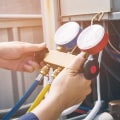
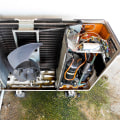
Most of the garage air conditioners I get called out to aren't dying. They're suffocating, under a layer of dust sitting on the underside of a coil you can't see from the front of the cabinet. That's what makes this decision so hard to get right. The machine gives you almost no visible evidence of what's actually wrong with it, so you end up judging it on the one thing you can feel, which is whether the garage is still hot. It usually is. That tells you nothing about whether to replace it.
The job out there is harder than anything cooling the inside of your house. Your garage runs 20 to 30 degrees above outdoor air on a summer afternoon, behind an overhead door that soaks up sun all day and radiates it back at you until nine at night. Sawdust, tire rubber, and grinding swarf load the coil in a way no living room ever will. Every symptom below comes out of that fight.
TL;DR Quick Answers
garage air conditioner
A garage air conditioner cools an unconditioned space that runs 20 to 30 degrees hotter than outdoor air, so it works harder than any unit inside your house. Window, portable, and ductless mini split models all do the job. Sizing and coil cleaning decide how long yours lasts.
Sizing decides everything. A unit that never satisfied the thermostat in its first summer was undersized, and no repair fixes that.
The coil is where garage units die. Sawdust, tire rubber, and grinding dust pack the underside where you can't see it, and airflow collapses.
Your overhead door is the biggest heat source. Uninsulated steel soaks up sun all day and radiates it back into the room until well after dark.
Ductless mini splits outperform window and portable boxes in a garage, because they move more heat per watt and hold up better against high ambient temperatures.
R-22 plus a leak means replace. New production ended in 2020, so every recharge on an older unit costs more than the last one.
Top Takeaways
A unit that never once reached setpoint in its first summer was undersized, not worn out, and buying the same capacity again repeats the mistake.
Short cycling in a garage points to a dust-packed coil far more often than a failing compressor, and the underside of that coil is where nobody looks.
R-22 plus a leak is the clearest replacement signal you'll get. R-22 on its own, in a unit holding its charge, isn't one.
Rising runtime at similar outdoor temperatures means capacity loss, and what it costs you monthly belongs in the replacement decision.
A garage that picked up a gym, a workshop, or an office didn't break the air conditioner. It outgrew it.
Age tells you when to start watching. It doesn't tell you when to start spending.
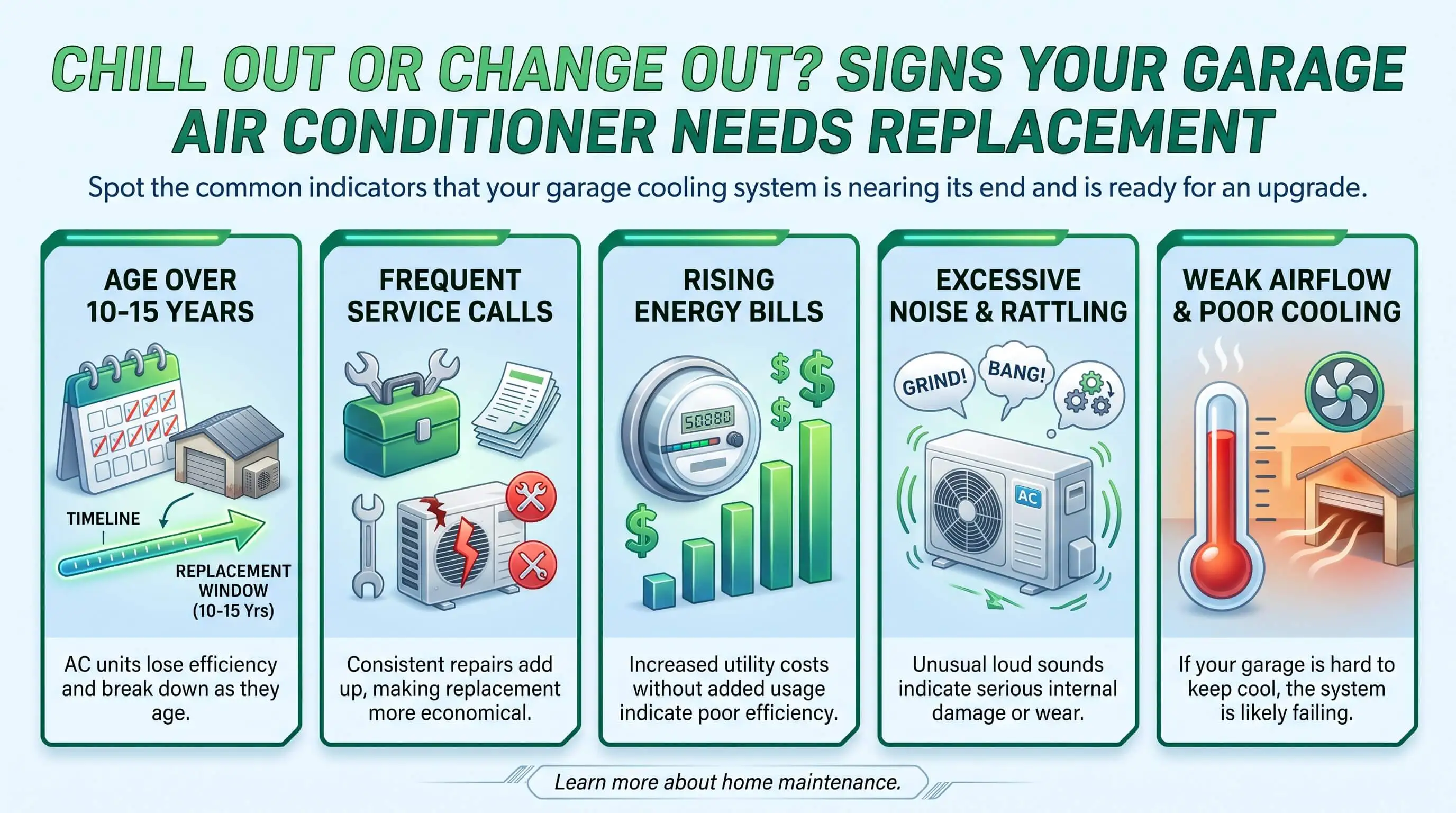
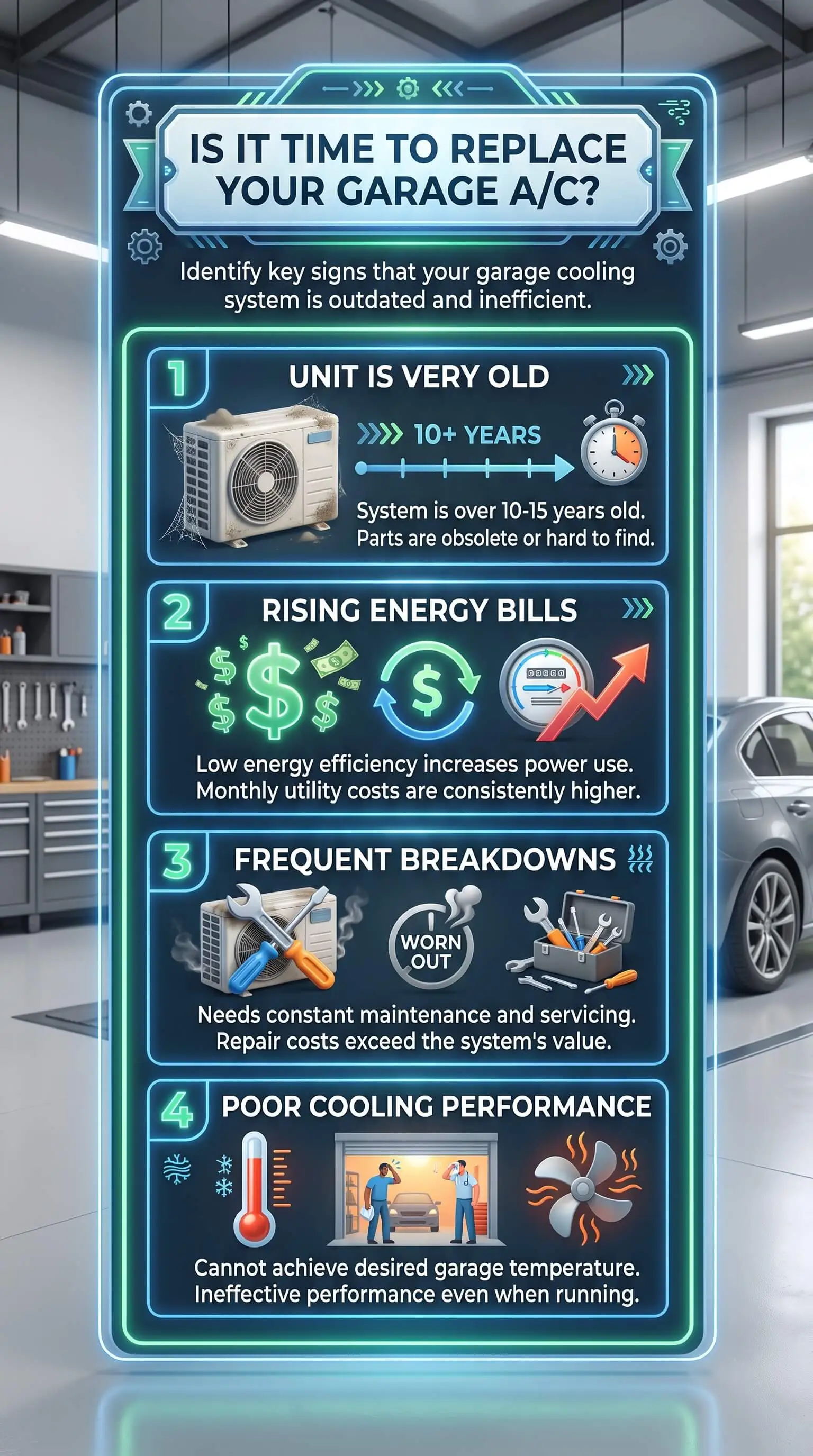
7 Warning Signs Your Garage Air Conditioner Is Done
Start with what the equipment actually does, because it changes how you read everything else. Air conditioning moves heat out of a space. It doesn't manufacture cold, and the amount of heat it can move per hour got fixed at the factory the day somebody built it. That number never grows. What follows is what Air conditioner problems look like when a fixed number loses a fight against a garage.
1. It Never Hit the Temperature You Set, and It Never Did
A unit that can't reach a setpoint in August looks identical to a unit that's dying. The difference is history. Think back to your first summer with it, on a 95 degree afternoon, and ask whether the thing ever shut itself off. If it did, something has degraded since then, and that's worth diagnosing before you spend a dollar on anything else, because a unit that used to satisfy the thermostat and now can't is a repair candidate first. If it never did, nothing has degraded. You bought an undersized unit, and you've spent every summer since watching it lose a fight it was never equipped to win. Replace it. Just don't replace it with the same capacity, because that hands you the identical problem with a newer serial number on it.
2. It Started Cycling On and Off Every Few Minutes
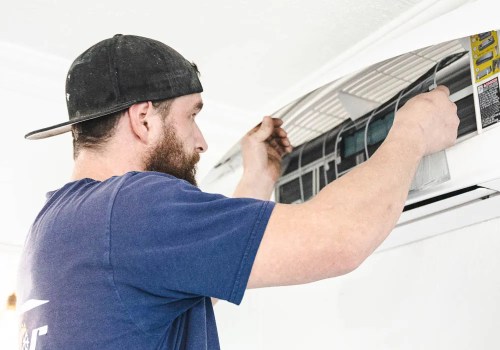
Short cycling that showed up recently is the sign people most often read as terminal, and it's the one I'm most likely to talk somebody out of. On a house system, I'd suspect refrigerant first. On a garage unit I go somewhere else entirely, because I pull the panel and check the underside of the evaporator coil, and that's where the garage particulate settles. You can shine a light straight at that coil, see clean fins, and be standing in front of a unit that's choked solid from below. Sawdust packs the fin spacing. So does drywall dust, tire rubber, and the fine metal swarf that comes off a bench grinder. Airflow collapses, the unit satisfies its own return sensor before the room has moved one degree, and it shuts down. Four minutes later it starts again. That's a cleaning, and I've watched units run another four summers after one. Get the coil pulled and inspected before you sign anything.
3. It Runs on R-22 and It's Losing Charge
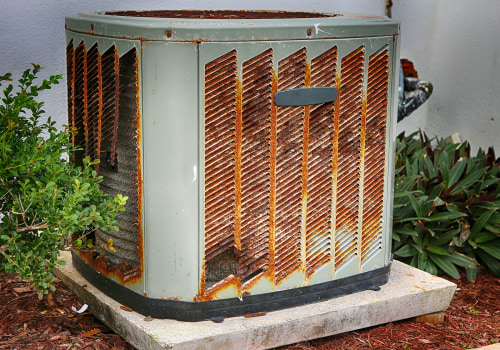
Two things have to be true here, and neither one means much on its own. The unit is charged with R-22, and it's lost enough of that charge to need topping up. Put them together and the math changes completely. New production and import of R-22 ended in 2020, so every pound still circulating comes out of recycled or stockpiled supply, and the price moves the way you'd expect. There's also a leak somewhere, by definition. You're paying a rising price to fill a container that won't hold what you put in it. Go read the data plate on the outdoor section, and if it says R-22 and somebody has already recharged it once, stop spending.
4. The Repair Quote Has Crossed the Line
The honest test isn't what the repair costs on its own. It's what the repair costs measured against a replacement, divided by how many summers this unit realistically has left. People skip that last number almost every time. A compressor or any sealed system repair on a garage unit past the middle of its life rarely pays back, because the next failure is usually already lined up behind the one you're fixing. A capacitor, a contactor, a fan motor, or a control board on a unit that otherwise performs will almost always pay back. Ask your technician which category yours falls into. Then ask what else they noticed while they had the panel off, because that second question is worth more than the first one.
5. Runtime Climbed and the Weather Doesn't Explain It
Compare this July against last July. Not against April. If the outdoor temperatures ran about the same and your unit now works noticeably longer to hold the same setting, capacity is falling off. Efficiency loss is gradual enough that nobody feels it day to day, which is exactly why it goes unnoticed for years at a stretch. Your power bill notices first. A unit that's quietly slipped into running most of the afternoon costs you real money every month, and that monthly number belongs in the decision right next to the repair quote.
6. Water Where It Shouldn't Be, or a Coil That Keeps Icing
Icing tells you something's wrong without telling you what. Restricted airflow and low charge are the usual causes, and a technician can fix either one. What I pay attention to is repetition. If somebody cleaned the coil, changed the filter, cleared the drain, and the thing iced over again three weeks later, the fault lives in the sealed system and you're back at sign three. Standing water in the bottom of the cabinet says the same thing from a different direction. So does a rusted drain pan. Water sat in there long enough to eat through metal, which means it sat in there for seasons.
7. The Garage Took On a New Job
Nothing has to be broken for this one to apply. The room changed underneath the equipment. A garage holding a car and a lawnmower carries a completely different cooling load from that same garage running a squat rack, a treadmill, and three people on a Saturday morning. Add a welder or an air compressor and it shifts again. Bodies throw heat, and so do motors. If the space picked up a new purpose while the air conditioner stayed exactly the same, you own a machine that's doing its job correctly and still failing you, because the job got bigger and nobody told the equipment. The room outgrew it.
Once you've decided the current unit is finished, the first real question is which category of equipment replaces it, not which model. Most garage replacements aren't like for like, because the portable or window box that just quit on you was usually a compromise on day one. Take some time with how to cool a garage across the different equipment types and sizing bands, including choosing the right garage air conditioner, before you commit to anything, particularly if that room now has a job it didn't have five years ago.
"The mistake I see most is people condemning a garage unit on short cycling alone. Nine times out of ten I pull the coil and find it packed solid with sawdust from the underside, where nobody ever thinks to look. Clean it out and the unit runs another four summers."
7 Essential Resources
Settle the Age Question Before You Spend Anything
The federal threshold for replacement timing, plus the efficiency gain a modern unit delivers over an old one. Read this first. It frames every other decision on this page. ENERGY STAR, When Is It Time to Replace?
Don't Throw Away the Efficiency You Just Paid For
A sloppy install strips a large share of the rated efficiency out of brand new equipment before you've run it once. If you're about to buy, this tells you what a correct installation involves, which means it also tells you what to hold your installer to. ENERGY STAR, Heat and Cool Efficiently
Compare Ductless Before You Buy Another Box Unit
Worth reading if your failing unit is a window or portable model, since the like-for-like swap is rarely your best move. ENERGY STAR, Ductless Heating and Cooling
Check Whether Your Refrigerant Is Still Being Made
This is the source behind sign three. It covers R-22 availability, what the phaseout means for servicing older equipment, and which refrigerants took its place. Five minutes here can save you a bad recharge decision. EPA, Homeowners and Consumers Frequently Asked Questions
Understand How Garage Air Gets Into the Rest of the House
Federal building science on why attached garages collect airborne contaminants and how pressure differences pull that air into your living space. Read it before you seal a garage up tighter around a new unit, because tightening the room changes what happens to the air inside it. PNNL Building America Solution Center, Mechanical Ventilation for Attached Garage
Keep Carbon Monoxide Out of a Space You've Sealed Up
Short and direct. Matters to anyone running an engine or a gas powered tool in the garage. EPA, Carbon Monoxide's Impact on Indoor Air Quality
See Why Attached Garages Count as an Indoor Air Source
The broader federal reference on household air quality, and it names attached garages specifically among the sources affecting the air inside your home. Useful context if that garage shares a wall with a bedroom. EPA, The Inside Story: A Guide to Indoor Air Quality
3 Statistics Worth Knowing
88 percent of U.S. households used air conditioning in 2020. Individual units, meaning window, wall, portable, and mini split equipment, serve as the primary cooling system for half of Northeast households. Source: U.S. Energy Information Administration.
Air conditioning ate roughly 19 percent of home electricity use in 2020. That works out to about 254 billion kilowatt hours nationally. An inefficient unit running long hours shows up as a line on your bill. Source: U.S. Energy Information Administration.
New production and import of R-22 ended on 1 January 2020. Servicing existing R-22 equipment now depends entirely on recycled and stockpiled supply. Source: U.S. Environmental Protection Agency.
These statistics show how common air conditioning is, how much electricity inefficient cooling can consume, and how older refrigerants can affect repair decisions, all of which can influence AC replacement cost when an aging garage unit becomes expensive to run or service.
Final Thoughts and Opinion
My honest opinion, after a lot of years walking into hot garages, is that most people replace two summers later than they should and the delay costs more than the unit ever did. The reasoning always sounds sensible at the moment. It still runs, it's only the garage, and another season won't kill anybody.
What that misses is that the final two summers of a failing unit are the two most expensive summers you'll ever pay for. Runtime sits at maximum, efficiency sits at minimum, and somewhere in the middle you buy a service call you won't get any value out of. Then you replace it anyway.
Where I'd push back is on replacing by age alone. A twelve year old unit that still hits setpoint, holds it, and has never needed refrigerant isn't a problem waiting to happen, especially when high quality filters help maintain proper airflow and support efficient operation. It's a machine doing its job. Age tells you when to start paying attention, and that's all it tells you.
Frequently Asked Questions
How long should a garage air conditioner last?
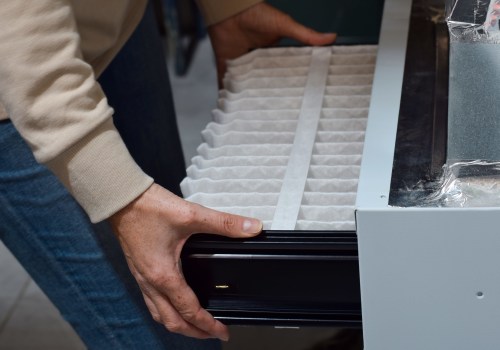
Expect fewer years than the same equipment would give you inside the house, because a garage unit runs against higher ambient temperatures and much dirtier air. Coil cleaning matters more here than anywhere else in your home, and proper maintenance for your HVAC system is the single biggest factor in how many summers you get out of one.
Is it worth repairing a garage AC that's more than ten years old?
Depends entirely on what failed. Capacitors, contactors, fan motors, and control boards are usually worth fixing on a unit that otherwise performs. Sealed system work, meaning the compressor or the refrigerant circuit, rarely pays back on older equipment because another failure is typically close behind it.
Why does my garage AC run constantly but never cool?
Usually one of a few things. The unit is undersized and always was, the coil is restricted and can't move air across itself, or the room gains heat through an uninsulated door faster than the equipment removes it. Start by asking whether it ever satisfied the thermostat in past summers.
Can I replace a garage air conditioner myself?
Portable and window units, yes. Anything involving a refrigerant line connection, no, both because federal rules govern refrigerant handling and because an improperly charged system fails early. Electrical work beyond a standard plug needs a licensed professional too.
Will a bigger unit fix a garage that won't cool?
Only if the current one is genuinely undersized. Oversizing carries its own failure mode, where the unit cools the air fast, shuts off before it has removed any humidity, and short cycles itself into an early grave. Get the load calculated instead of guessing upward.
CTA
Knowing when to replace a garage air conditioner comes down to whether the unit was ever right for the room, whether MERV 8 pleated HVAC furnace air filters are supporting proper airflow in a compatible system, and whether it can still hold a setpoint. Take these seven signs out to your own garage and you'll have your answer.